Bank Reported Wrong Data to CIBIL? Here Is How to Get It Corrected
Last fact-checked: 13 July 2026
Important: This is a general consumer-education guide, not legal advice. Contact details and grievance officers can change, so use the linked official grievance page before sending a complaint. Never publish or email your complete card number, CVV, OTP, CIBIL login password or an unmasked identity document.
Your credit report can say you missed a payment even when your bank statement proves the opposite. It can show an overdue amount before the due date, keep a closed loan open, duplicate an account, attach somebody else’s loan to your PAN, or record “settled” when you paid in full.
These are not cosmetic mistakes. Incorrect data can reduce your credit score, make a lender price your loan more aggressively, delay an application, or cause it to be rejected. The good news is that you do not have to wait passively for the next reporting cycle. You can dispute the entry with both the lender and CIBIL, create a dated evidence trail, and escalate if the correction is not completed on time.
This guide works across banks, NBFCs and credit-card issuers in India. A separate section explains the reported SBI Card issue that surfaced in July 2026.
First, understand who can correct the entry
TransUnion CIBIL is a Credit Information Company (CIC). The lender, called a Credit Institution (CI) in RBI rules, supplies account and repayment data to CIBIL. CIBIL uses that lender-supplied information in your Credit Information Report and score; it does not independently decide that you were late.
If a lender supplied the wrong overdue amount or payment status, CIBIL ordinarily needs the lender’s confirmation before changing it. CIBIL says it routes a dispute to the concerned credit institution and cannot alter lender-supplied data without its authorisation. That is why the fastest practical approach is to complain on both tracks at the same time:
- File a written correction complaint with the bank, NBFC or card issuer that reported the data.
- Raise an online dispute with TransUnion CIBIL.
Do not complain only about the score. Identify the inaccurate data field, such as Amount Overdue, Days Past Due (DPD), Current Balance, Date Closed, Account Status or Ownership. RBI’s compensation framework covers delayed correction of inaccurate credit information; it does not cover a disagreement with CIBIL’s score-calculation model.
What to check in the full report
A score alone will not tell you what went wrong. Download the detailed report and inspect the account section line by line.
Look for:
- an overdue amount when the bill or EMI was paid on time;
- DPD other than
000orSTDfor a month in which no payment was late; - an incorrect Current Balance or Amount Overdue;
- a closed account still marked open;
- “settled”, “written off”, “wilful default”, “suit filed” or another adverse status that is factually wrong;
- a duplicate account;
- a loan, card or enquiry that does not belong to you;
- a wrong credit limit, sanctioned amount, opening date or closure date;
- incorrect name, PAN, date of birth, phone number or address; and
- whether the error appears in the latest CIBIL report.
Save the report as a PDF. Record its report date, control/reference number, lender name, masked account number, disputed field, reporting month and reported value. Take a screenshot of the exact entry as backup.
The correction process: a step-by-step playbook
Step 1: Rule out a timing or payment-allocation issue
Before accusing the lender of incorrect reporting, compare these dates and amounts:
- statement or EMI generation date;
- contractual due date;
- total amount due and minimum amount due;
- payment date, value date and amount;
- reversal or failed-payment entries;
- refunds, EMI conversions and disputed transactions; and
- the “date reported” shown in the credit report.
A payment made through a third-party channel can have a later value date. A returned auto-debit can also create a genuine delay even if you later paid manually. If the evidence still shows that the lender’s entry is impossible or inaccurate, proceed immediately.
Step 2: Build one clean evidence pack
Attach only documents that prove the error:
- the relevant credit-report page;
- the statement showing the amount and due date;
- payment receipt, bank debit entry or UTR/reference number;
- a no-dues or closure letter, if applicable;
- prior complaint acknowledgements; and
- a one-page timeline.
Mask unrelated transactions, all but the last four digits of account/card numbers, Aadhaar details and other unnecessary personal information. Keep unredacted originals with you.
Step 3: Complain to the lender in writing today
Use the lender’s official app, complaint form or registered email channel. A phone call can help, but it is not a substitute for a dated written complaint. Ask for a service-request or complaint number.
Your subject line should be specific:
Urgent correction of inaccurate CIBIL reporting | [masked account/card] | [wrong field and reporting month]
Ask the lender to:
- investigate the exact field and reporting period;
- send the corrected data to TransUnion CIBIL;
- remove the inaccurate overdue/DPD/status rather than merely mark the account paid in a later month;
- confirm the date on which the corrected file was submitted and accepted;
- provide written closure and a corrected data position; and
- pay compensation if the correction exceeds the RBI timeline.
Do not write “improve my score to 780”. The lender controls its data submission, not the score model. Ask for factually correct reporting.
Step 4: Raise a CIBIL dispute in parallel
Use CIBIL’s official dispute facility:
Choose the precise account and field. Enter the correct value, explain why the reported value is wrong, and upload concise evidence where the portal permits. Save the dispute ID and acknowledgement email.
If incorrect information was supplied by more than one lender, RBI says the complaint should be registered with the concerned CIC, which must coordinate with the credit institutions involved and provide a comprehensive resolution.
Step 5: Escalate inside the lender without resetting the clock
If frontline support closes the complaint without correcting the report, escalate with the original complaint number and date:
Level 1: customer care / branch / card-service team
Level 2: grievance redressal or nodal officer
Level 3: principal nodal officer / customer service head
External: RBI Ombudsman through the CMS portal when eligible
Use the official matrix in the appendix below. Do not start a brand-new complaint every time; quote the first complaint so the timeline remains traceable.
Step 6: Verify the data, not just the closure email
A message saying “resolved” is not proof that CIBIL has ingested the correction. Check:
- Amount Overdue is zero for the correct month, if that is factually correct;
- the incorrect DPD or adverse status has been replaced;
- the historical month itself is corrected, rather than a later month merely showing payment;
- the latest CIBIL report reflects the correction; and
- there is no duplicate account or fresh error.
Keep the corrected report and closure letter permanently. A score can take time to recalculate and its exact movement is not guaranteed, but the underlying record should be accurate.
RBI’s 30-day rule and ₹100-per-day compensation
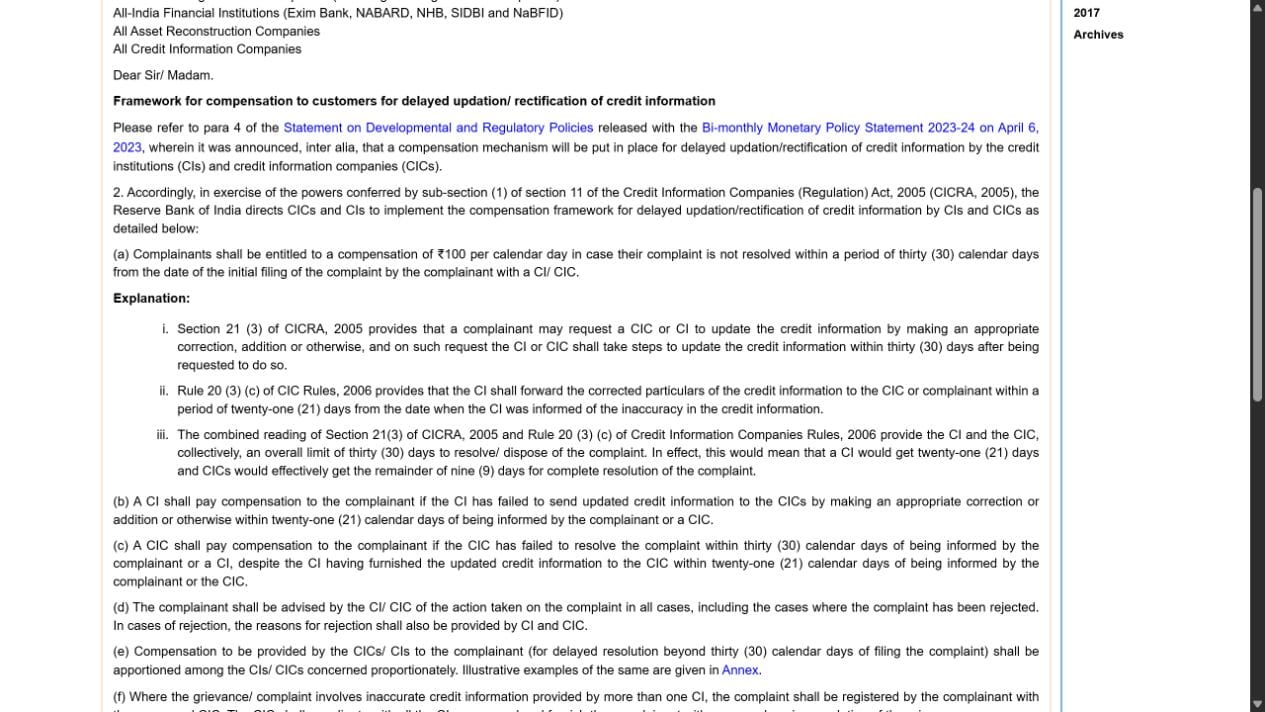
RBI circular RBI/2023-24/72, DoR.FIN.REC.48/20.16.003/2023-24, dated 26 October 2023, created a compensation framework for delayed updation or rectification of credit information. It became effective six months later, on 26 April 2024.
The rule is often oversimplified online. Here is what it actually says:
- The credit institution and CIBIL collectively get 30 calendar days from the initial correction complaint.
- The credit institution gets 21 calendar days to send the corrected information.
- CIBIL effectively gets the remaining 9 calendar days to complete resolution.
- If the complaint is not resolved within 30 calendar days, the complainant is entitled to ₹100 for each calendar day of delay.
- Responsibility can fall on the lender, CIBIL, or be apportioned between them.
- “Resolved” means the rectified Credit Information Report has been sent to the postal or email address provided by the complainant.
- Compensation must be credited within five working days after resolution.
- The customer should provide correct contact and bank-account or UPI details for payment.
- If compensation is wrongly denied, the complainant may approach the RBI Ombudsman.
Read the official RBI circular and its official PDF.
Simple compensation example
Suppose your first correction complaint was registered on 2 August and the rectified report was sent on 15 September. Count the calendar days under the applicable RBI framework and subtract the first 30 days. If the eligible delay is 14 days, the compensation would be 14 × ₹100 = ₹1,400, subject to the framework’s applicability and exclusions.
Do not confuse this with RBI Ombudsman eligibility. The Reserve Bank–Integrated Ombudsman Scheme, 2026 (RB-IOS, 2026) replaced the 2021 scheme on 1 July 2026. You must first complain to the regulated entity. You may then approach the RBI Ombudsman if no reply arrives within 30 days (or a longer timeline specified by RBI, NPCI or a card network, where applicable), or earlier after receiving a reply/resolution with which you are dissatisfied. Under the 2026 scheme, the Ombudsman complaint must generally be filed within 90 days after the applicable response period expires or the regulated entity’s last communication, whichever is later. File through the RBI Complaint Management System and attach your original complaint, reply, evidence and CIBIL dispute details. Read RBI’s current RB-IOS 2026 FAQ.
What the automatic framework does not cover
The circular excludes, among other things, complaints that challenge the computation of a credit score or score model and matters already decided by or pending before specified other forums. Frame your complaint around the incorrect reported information and delayed rectification.
Reported SBI Card error in July 2026: what cardholders should know
On 12–13 July 2026, multiple SBI Card users posted screenshots and accounts online alleging that an amount not yet due, or already paid, had appeared as Amount Overdue in their TransUnion CIBIL reports. Some users reported score drops of roughly 60–70 points.
At the time this article was fact-checked, these were contemporaneous customer reports; no public SBI Card statement confirming the cause, scale or affected population was located. It is therefore more accurate to call this a reported reporting issue, not to assert that every SBI Card account was affected or that a specific number of customers suffered an error.
The allegations are nevertheless serious because an amount cannot logically be overdue before its contractual due date. SBI Card itself explains that CIBIL cannot independently change lender-supplied information and that a correction must be confirmed by the relevant bank or financial institution.
An anonymised illustration
The following figures have been altered for privacy and should not be treated as the data of a named complainant.
- Statement generated: 8 July 2026
- Total amount due: ₹2,146.70
- Minimum amount due: ₹1,020
- Payment due date: 28 July 2026
- Full payment made: 11 July 2026
- CIBIL entry: ₹1,020 shown as Amount Overdue as of the reporting date
- Score movement noticed by the user: 786 to 721
If those facts are supported by the statement and payment proof, the overdue entry would be internally inconsistent: the full bill was paid before the due date, and the due date had not arrived when the account was allegedly reported overdue.
What an affected SBI Card user should do
- Download the full CIBIL report and screenshot the SBI Card account entry.
- Save the July statement and proof of full payment/value date.
- Register a complaint through SBI Card’s official contact page or app and retain the Interaction ID.
- Raise a parallel dispute through CIBIL.
- If needed, escalate in sequence to the addresses published in SBI Card’s official grievance policy:
[email protected],[email protected], and[email protected]. The SBI Card PDF still refers to the 2021 Ombudsman scheme, but external complaints filed from 1 July 2026 are governed by RB-IOS, 2026. - Ask SBI Card to correct the CIBIL entry and confirm the submission/acceptance date in writing.
- If unresolved after the applicable period, seek RBI-framework compensation and escalate through RBI CMS.
Do not send a threatening or mocking complaint. A precise, evidence-led escalation is easier for a grievance officer, CIBIL and the Ombudsman to act on.
General complaint draft for any bank, NBFC or card issuer
Subject: Correction of inaccurate CIBIL reporting | [masked account/card number] | complaint dated [date]
Dear Grievance Redressal Officer,
I am requesting urgent rectification of inaccurate credit information reported by [lender name] for my [loan/credit-card type] ending [last four digits].
Disputed information
- Credit information company: TransUnion CIBIL
- Report date and reference/control number: [details]
- Reporting month/date: [details]
- Field reported incorrectly: [Amount Overdue / DPD / Current Balance / Account Status / Date Closed / Ownership / other]
- Value presently reported: [value]
- Correct value/status: [value]
Why the entry is inaccurate
[Write a short factual timeline. Example: The statement was generated on __, payment was due on , and the full amount of ₹ was credited on __ under reference __. The attached statement and payment confirmation show that no amount was overdue for the disputed reporting period.]
I request that you:
- investigate and correct the inaccurate field for the original reporting period;
- submit the corrected information to TransUnion CIBIL;
- confirm the correction-file submission and acceptance dates;
- send me a written resolution and the corrected credit-information position; and
- credit any compensation due under RBI circular RBI/2023-24/72 if resolution exceeds the prescribed timeline.
Attachments: [credit-report extract, statement, payment proof/UTR, closure/no-dues letter, earlier complaint acknowledgement]
Please acknowledge this complaint with a unique reference number. My contact and compensation-payment details are: [registered email/mobile and bank account or UPI details, shared only through the lender’s secure/official channel].
Regards,
[Full name]
[Registered mobile/email]
[Masked account/card number]
SBI Card escalation draft for the reported July 2026 issue
Subject: Incorrect Amount Overdue reported before due date | SBI Card ending [1234] | immediate CIBIL correction required
Dear Grievance Redressal Officer,
I am escalating an inaccurate overdue entry reported for my SBI Card ending [1234].
My statement dated [date] showed a total amount due of ₹[amount], payable by [due date]. The full amount was credited on [payment/value date], under payment reference [reference]. However, my credit report dated [date] shows ₹[amount] as Amount Overdue for this account.
This entry is inconsistent with the attached records because [the full payment was credited before the due date / the contractual due date had not arrived / other exact reason]. I have not asked for a discretionary score increase; I am asking SBI Card to correct the inaccurate data it supplied.
Please:
- correct the Amount Overdue and any related DPD/adverse status for the original reporting period;
- transmit the correction to TransUnion CIBIL;
- confirm the file-submission and CIBIL-acceptance dates;
- provide a written resolution and corrected credit-information position; and
- process compensation under RBI circular RBI/2023-24/72 if the rectified report is not provided within the prescribed period.
Attached are the relevant statement, payment confirmation, credit-report extract and my original complaint acknowledgement.
Regards,
[Full name]
[Registered mobile/email]
[SBI Card ending 1234]
[Original Interaction ID and complaint date]
RBI Ombudsman complaint checklist
When the complaint becomes eligible for external escalation, submit it through cms.rbi.org.in. Include:
- the regulated entity’s exact legal name;
- original complaint date and reference number;
- a chronological statement of facts;
- the inaccurate field and the correct value;
- the lender’s reply showing why you are dissatisfied, or proof that the applicable response period elapsed without a reply;
- CIBIL dispute IDs and status emails;
- statement/payment/closure evidence;
- the latest report showing the error remains;
- the correction requested;
- ₹100-per-day compensation claimed under RBI/2023-24/72, with calculation; and
- evidence of actual financial loss, if you claim any separate relief.
Keep the language factual. Do not exaggerate the score impact or claim a loan rejection without documentary proof. Merely copying an RBI email address on your message to the bank is not an Ombudsman complaint; RB-IOS, 2026 expressly treats communications in which RBI is only marked in copy as non-maintainable.
Credit-card issuer escalation directory
The correct entity is the lender/card issuer named in your credit report and card agreement, which may differ from the app or co-brand printed most prominently on the card. Start at Level 1, retain the reference number, then use the official grievance/escalation page. Officer names, email addresses and telephone numbers change; the official linked matrix is safer than copying an old address from a forum post.
This directory covers mainstream banks and standalone card issuers serving Indian retail credit-card users. A bank that does not issue your card is not part of your dispute simply because you used its account to pay the bill.
Co-branded and app-led cards
For OneCard, fintech, BNPL or co-branded products, read the account entry and Most Important Terms and Conditions to identify the regulated issuer. Complain to the app’s support team and the bank/NBFC that appears as the credit institution. The RBI complaint must name the regulated entity, not merely the consumer-facing app.
Frequently asked questions
Should I wait 30 days before raising a CIBIL dispute?
No. Raise the lender complaint and CIBIL dispute promptly. The 30-day period is a resolution window and the point after which delayed-correction compensation may begin; it is not a waiting period before you are allowed to report the error.
Will paying the amount make the old late-payment mark disappear?
Not necessarily. A later payment can update the current balance while leaving the historical DPD or overdue entry intact. If the historical entry was wrong, explicitly ask for correction of that original reporting period.
Can CIBIL correct the report without the bank?
CIBIL can validate and route the dispute, but lender-supplied account data generally requires confirmation from the concerned credit institution. This is why parallel complaints matter.
Should I complain to both the lender and CIBIL?
Yes. Complain to the lender because it supplied the disputed data, and raise a parallel CIBIL dispute so the entry is formally tracked. CIBIL generally needs the lender’s confirmation before changing lender-supplied account information.
Is a 60-point drop proof that the bank made an error?
No. A score can move for several reasons, including reported late payment, utilisation, new enquiries, account age and model changes. The proof is the inaccurate account-level field compared with your statement, due date and payment record.
How often is credit information reported?
RBI required credit institutions and CICs to update credit information on a fortnightly basis, on the 15th and last day of the month or more frequently if agreed, from 1 January 2025. That improves update frequency but does not replace the formal correction process for an inaccurate historical entry.
Final takeaway
When a bank reports wrong credit data, speed and documentation matter more than anger. Download the full CIBIL report, identify the exact field, complain to the lender and CIBIL on the same day, preserve the first complaint date, escalate through the official matrix, and verify the latest CIBIL report after correction.
RBI’s framework gives the lender and CIBIL 30 calendar days collectively. If they exceed that period in an eligible rectification complaint, ₹100 per calendar day is not a social-media rumour. It is part of the RBI’s compensation framework.
Primary and supporting sources
- RBI: Framework for compensation to customers for delayed updation/rectification of credit information
- RBI: Integrated Ombudsman Scheme, 2026 FAQ
- RBI Complaint Management System
- RBI circular RBI/2024-25/60: fortnightly reporting of credit information
- CIBIL: consumer dispute information
- CIBIL: RBI compensation framework
- SBI Card: CIBIL and credit-reporting FAQs
- SBI Card: grievance redressal policy
- Contemporaneous SBI Card user report, 12 July 2026
- Second contemporaneous SBI Card user report, 12 July 2026