
Paid Credit Card Bill On Time, Reported Late: What to Do When a Bank Damages Your CIBIL Report
You pay your credit-card bill on time. The money leaves your account. The card app shows the payment. You move on.
Weeks later, you check your CIBIL report and find an overdue entry.
Your score may have fallen. A lender reviewing your report may now see you as someone who missed a payment, even though you did everything right.
This is not a minor reporting glitch. An incorrect overdue can affect your next credit-card application, car loan or home loan. It deserves immediate attention.
The good news is that the error can be corrected. The process becomes much easier once you understand who controls the information and where to complain.
Start with one crucial question
Did you pay before the due date, or was the payment also credited before the due date?
The distinction matters.
Pull out the statement and compare:
- Total amount due
- Payment due date
- Payment date
- Date the money left your bank
- Date the lender credited the payment
- Transaction reference or UTR
If the complete amount was credited by the due date, an overdue entry is likely incorrect.
If you initiated the payment on the final day but the lender credited it later, check the payment terms and processing timeline. If the delay happened after a successful on-time payment because of the lender’s system, include that fact in your complaint.
If you paid after the due date, the historical late-payment entry may be accurate even if the balance is now zero.
Do not rely on a score shown in an app
Many financial apps can show your CIBIL score. They are useful for routine monitoring and may be the reason you discover the problem.
But when you want a bank to correct an entry, download the latest report directly from the official CIBIL website.
The official report is your working document. It shows how the lender reported the account and contains the details needed to investigate the error.
Find the affected account and examine:
- Current balance
- Amount overdue
- Account status
- Payment history
- Days Past Due or DPD
- Last payment date
- Date Reported
Do not confuse a current balance with an overdue.
A credit card may show a current balance because you made new purchases after paying the previous statement. The Amount Overdue and DPD fields are the ones that indicate whether the lender treated your payment as late.
The Date Reported tells you when the lender last sent information to CIBIL. If the lender has not reported since your payment, the report may be waiting for its next update. If it has reported a late payment for a bill you paid on time, you have a clear reason to dispute it.
Build a clean evidence trail
Before calling customer care, create one folder containing everything connected with the payment:
- Credit-card statement or loan repayment schedule
- Payment receipt
- Bank statement showing the debit
- Transaction reference or UTR
- Successful payment confirmation
- Official CIBIL report
- Screenshot of the incorrect entry
- Previous complaint references, if any
This turns a vague complaint into a verifiable case.
Avoid sending your full card number. The final four digits are usually enough. If you are asked to submit PAN or another identity document, watermark the copy with the complaint purpose and date.
The bank, not CIBIL, must validate the correction
This is the part many consumers miss.
CIBIL displays the information supplied by banks and NBFCs. It cannot independently decide that your payment was on time and rewrite the lender’s records.
The reporting institution must check the payment and confirm the correction.
That is why you should take two actions together:
- Complain directly to the bank or NBFC.
- Raise a dispute through CIBIL.
If you complain only to CIBIL, the dispute will eventually return to the lender for verification. If you complain only to the lender, you may lose the visibility and formal tracking provided by the CIBIL dispute process.
Doing both creates a stronger paper trail.
Write to the lender, do not depend on phone calls
A phone call can help you understand the problem, but it is not a substitute for a written complaint.
Email the lender’s:
- Customer service team
- Credit-information or CIC dispute team
- Grievance Redressal Officer
If the first response is unsatisfactory, escalate the same email chain to the Principal Nodal Officer.
Ask the lender to do more than “check the issue.” Be specific.
Request that it:
- Reconcile the payment
- Confirm the payment credit date
- Correct the Amount Overdue
- Correct the DPD and payment history
- Correct the account status and balance, if necessary
- Reverse any related late fee or finance charge
- Send corrected data to all four credit bureaus
- Confirm the correction in writing
India has four credit bureaus: CIBIL, Experian, Equifax and CRIF High Mark. An error discovered in CIBIL may also appear elsewhere.
A complaint format that gets to the point
Subject: Incorrect overdue and DPD reported despite timely payment
Dear Sir/Madam,
I am disputing the overdue or delayed-payment information reported for my [credit card/loan] account ending [XXXX].
I paid the complete amount due within the payment due date. Despite this, your institution has reported an overdue amount or delayed-payment entry in my credit report.
Statement/EMI amount: ₹[Amount]
Payment due date: [Date]
Amount paid: ₹[Amount]
Payment date: [Date]
Payment reference/UTR: [Reference]
CIBIL report date: [Date]
The attached statement, payment receipt and bank statement confirm that the complete payment was made within the due date.
Please reconcile the payment and correct the Amount Overdue, DPD, payment history and account status. Please also reverse any charges caused by this error and submit corrected information to CIBIL, Experian, Equifax and CRIF High Mark.
Kindly provide a complaint reference number and confirm the date on which corrected information is sent to each bureau.
Regards,
[Name]
[Registered mobile number]
[Registered email address]
Keep the language calm and factual. You are building a record that may later be reviewed by the bank’s nodal officer or the RBI Ombudsman.
Raise the CIBIL dispute correctly
Open the CIBIL Consumer Dispute Resolution portal and sign in.
From your latest report:
- Open the affected account.
- Choose the option to raise a dispute.
- Select Account Information or Account Details.
- Mark the fields that are incorrect.
- Enter the correct information.
- Submit the dispute.
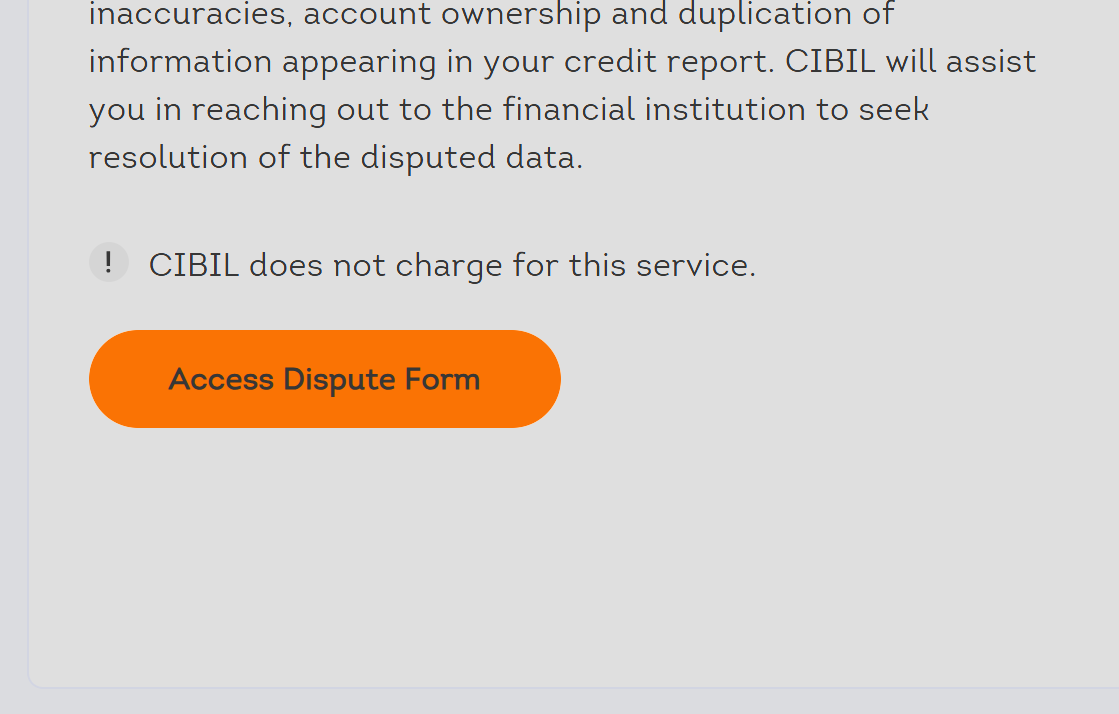
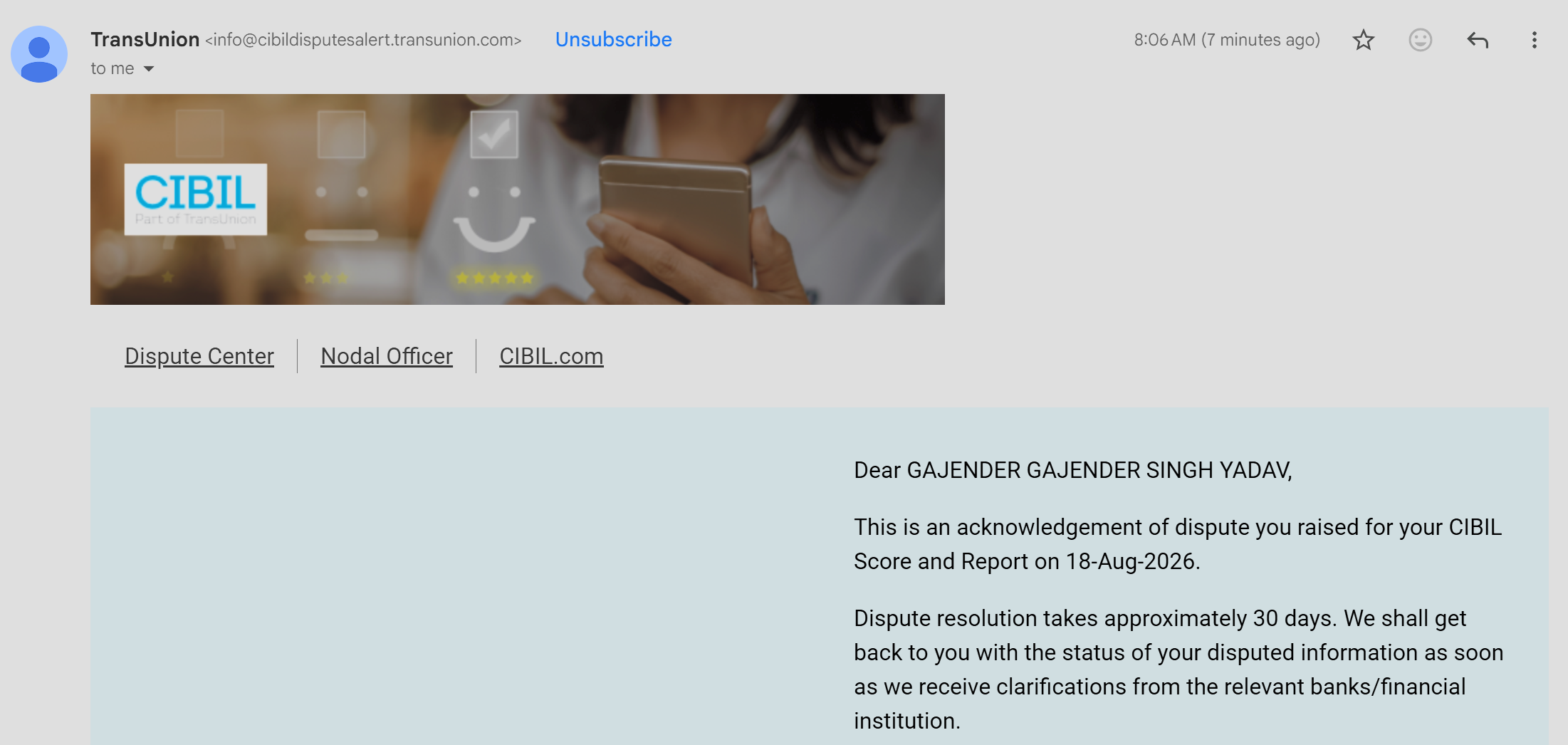
- Save the dispute ID and submission date.
You may need to dispute:
- Amount Overdue
- Payment History or DPD
- Current Balance
- Account Status
- Last Payment Date
If the account genuinely belongs to you, do not choose “Account does not belong to me.” You are challenging the payment information, not ownership.
A simple dispute comment is enough:
The complete amount due was paid and credited within the payment due date. Please verify the payment with the reporting institution and correct the Amount Overdue, DPD and payment history.
CIBIL will forward the dispute to the lender. It can update the report after the lender confirms the correction. CIBIL’s dispute guidance
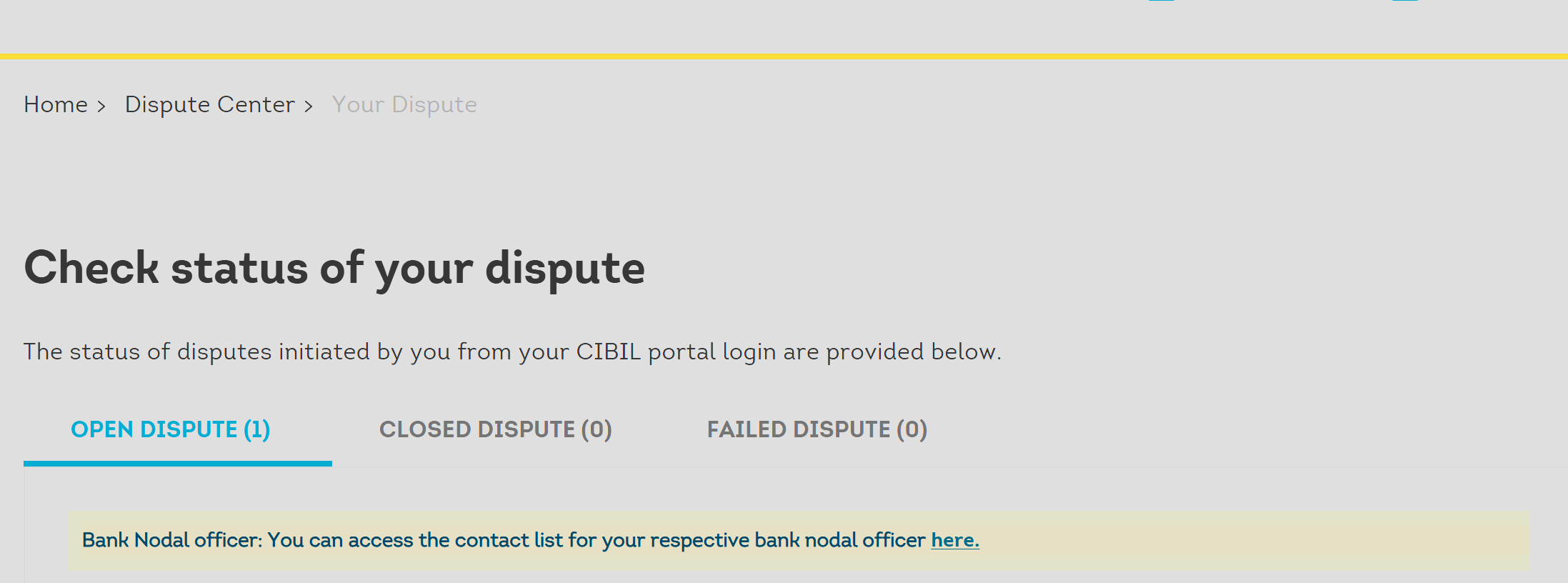
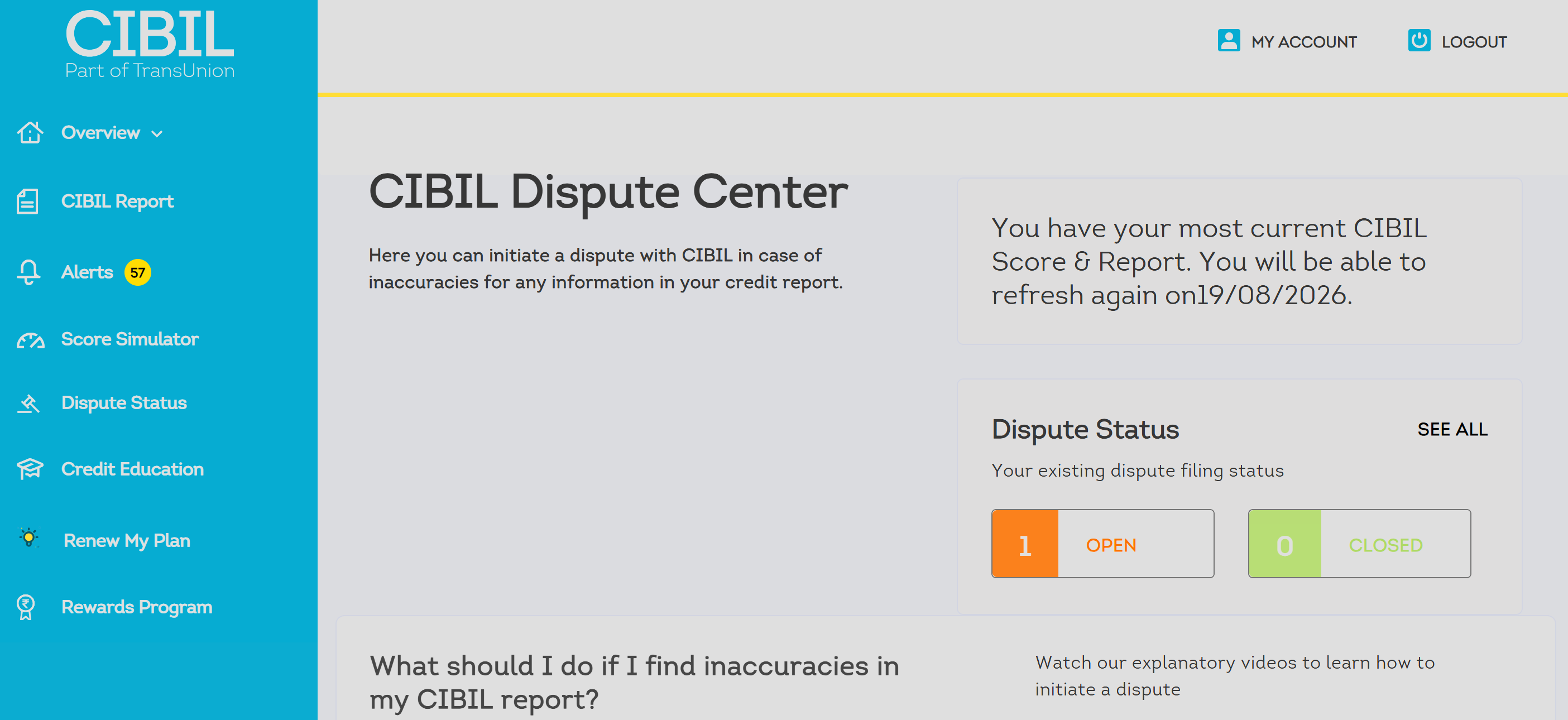
This happened with my Jupiter Edge credit card
I came across this problem through my Jupiter Edge credit card.
The complete statement amount was paid within the due date, but an overdue was reported against the account.
The card operates through Jupiter, but CSB Bank is the regulated issuer. That meant the complaint could not stop with Jupiter’s in-app support. CSB Bank, as the institution reporting the account to the credit bureaus, had to verify and correct the information.
For the Jupiter Edge or Edge+ CSB Bank credit card, the complaint can be sent to:
The email should include the statement, payment receipt, bank debit entry, UTR, official CIBIL report and CIBIL dispute ID.
CSB Bank also provides a dedicated route for credit-information disputes on its complaints redressal page.
The lesson applies well beyond Jupiter: if a financial product is offered through an app, identify the bank or NBFC that actually issued and reported the account. The app may handle customer service, but the regulated lender controls the credit-bureau reporting.

Give the correction process 30 days, not forever
Under RBI’s credit-information correction framework, the lender and credit bureau collectively have 30 calendar days to resolve a complaint.
The framework generally gives the credit institution 21 days to send corrected information and the credit bureau the remaining nine days to complete the resolution.
Keep a record of the date you first filed the complaint. Save every acknowledgement and response.
If the lender does not resolve the matter, escalate it to the Principal Nodal Officer. Do not start a fresh complaint without referencing the earlier one. Continue the same written trail.
If the bank still does not correct it
Once 30 days have passed, or if the lender rejects the complaint and you disagree with its response, escalate through the RBI Complaint Management System.
Attach:
- Official CIBIL report
- Statement or repayment schedule
- Payment receipt
- Bank statement
- UTR or transaction reference
- Complaint emails
- Lender’s response
- CIBIL dispute acknowledgement
- Nodal officer escalation
Explain the issue in one sentence:
The complete payment was made within the due date, but the lender reported an overdue or DPD and failed to correct the inaccurate credit information.
That sentence should sit at the top of the complaint. Let the documents prove the rest.
There may also be compensation for delay
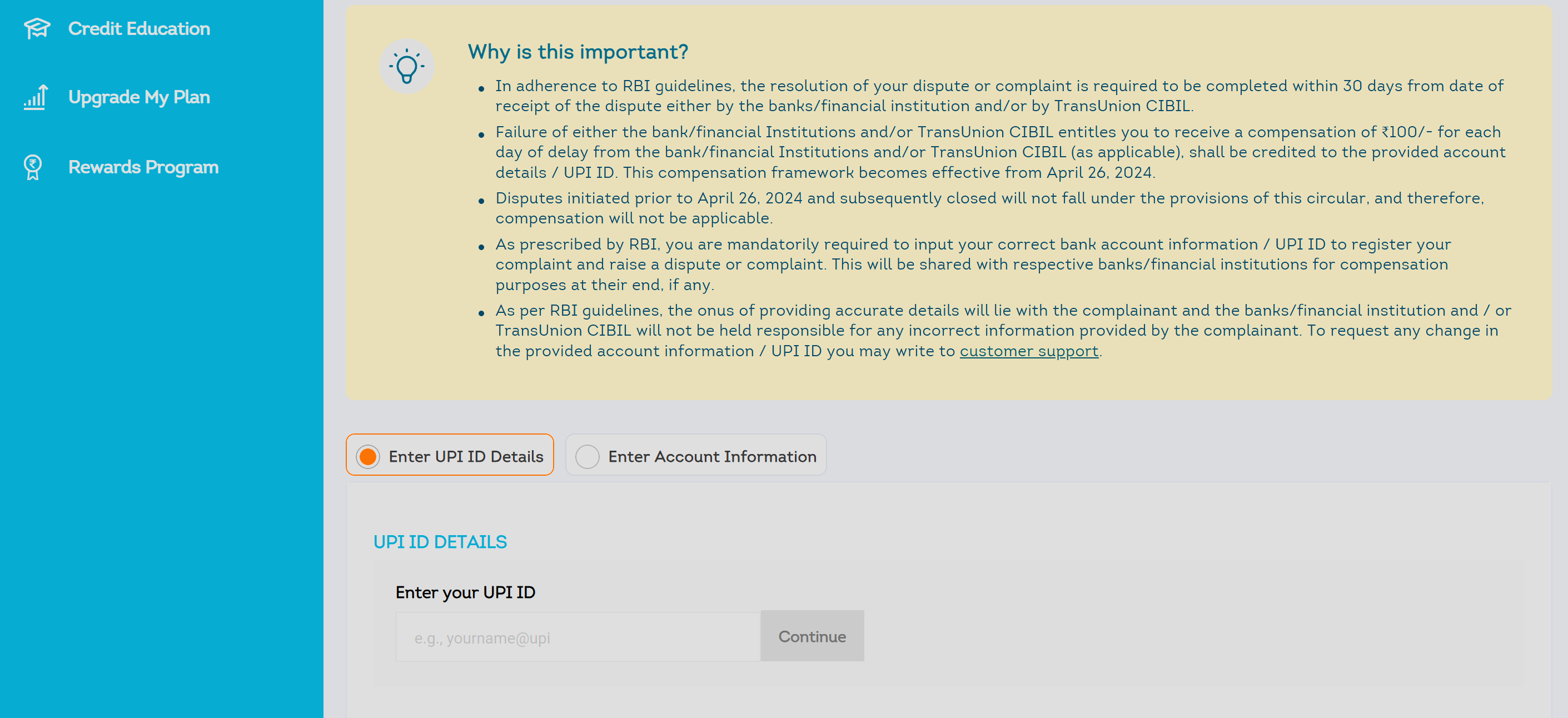
RBI’s framework provides compensation of ₹100 for each calendar day of delay beyond 30 days in eligible credit-information correction cases.
The compensation is for delayed resolution. It is not automatically payable simply because your score fell.
If the correction crosses the 30-day deadline, ask the lender and CIBIL to confirm:
- How many days the complaint was delayed
- Which organisation caused the delay
- The compensation payable
- When it will be credited
CIBIL explains the framework on its compensation page.
What happens to your score after correction?
The score may not recover the moment the bank sends its response.
First, the lender must submit corrected information. CIBIL must then update the account and recalculate the score. The eventual change will depend on the rest of your credit profile.
Do not ask CIBIL to restore a specific number. Ask for the inaccurate information to be corrected:
- Amount Overdue
- DPD
- Payment history
- Account status
- Current balance
Once the underlying data is corrected, the score can reflect the revised credit history.
The practical takeaway
A wrong overdue is frustrating because it makes a responsible borrower look careless. But the correction process becomes manageable once you follow the right order.
Download the official report. Gather your payment proof. Complain to the institution that reported the account. Raise a CIBIL dispute at the same time. Check the other three bureaus. Escalate after 30 days if necessary.
A credit-score app may help you discover the problem. The official report and your written evidence are what help you fix it.