HDFC BizBlack Devaluation: What Your Next Tax Payment Will Really Earn
HDFC BizBlack changes from 21 December 2026: tax reward cuts, the ₹50,000 retail-spend rule, 7,500-RP cap maths and quarterly milestones explained.
 Gajender Yadav
13 min read
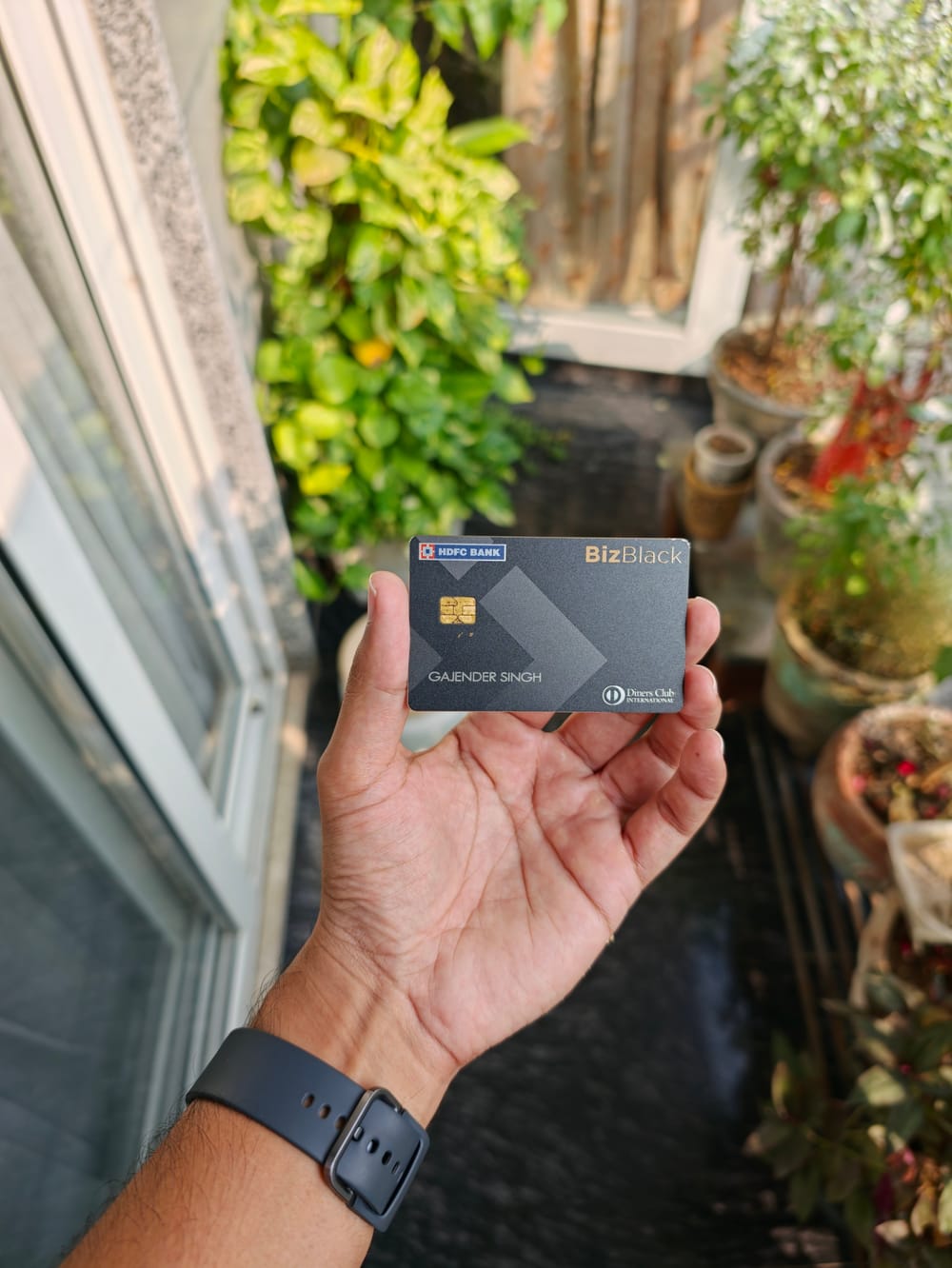
Imagine this. Your advance tax payment is due. You open the payment page, reach for your BizBlack and think about the points that will come with a bill you have to pay anyway.
That was a big part of this card’s appeal. An unavoidable business expense could help pay for a future flight or hotel stay. Tax payments could also help you reach the spending requirement for 5X rewards and move you closer to a milestone voucher.
From 21 December 2026, that calculation changes.
Before looking at the points on your tax bill, you will have to answer another question: have you spent ₹50,000 on qualifying purchases apart from Income Tax and GST in the same billing cycle?
If the answer is no, the tax payment will not unlock 5X on its own. Even if the answer is yes, the tax earning rate is lower. And those tax payments will no longer help you reach the revised milestone vouchers.
HDFC has also lowered the voucher target from ₹5 lakh to ₹4 lakh. That sounds welcome, but there is a catch: you now have a separate target every quarter.
At Book1A, we would look at these changes through one question: what will your existing spending actually earn after the revision? Let’s work through it, one tax bill and one spending pattern at a time.
A quick note before the numbers: we value one Reward Point (RP) at ₹1 in the examples. That is a redemption assumption, not cash arriving in your account. If you get less value from your points, your return will be lower. Figures are before payment fees and applicable caps unless stated otherwise; transaction-level rounding can affect the final points.
The old card versus the revised card
| Feature | Previous structure | Revised structure |
|---|---|---|
| Base rewards on eligible Income Tax/GST payments | 5 RP per ₹150 | 4 RP per ₹200 |
| Potential base redemption value at ₹1/RP | Approximately 3.33% | 2% |
| Potential tax rewards at 5X, before caps | Approximately 16.67% | 10%, if 5X multiplies the revised tax base rate |
| Spending required to unlock business-category 5X | ₹50,000 statement-cycle threshold; tax spends could contribute | ₹50,000 qualifying retail spends per billing cycle, excluding Income Tax/GST |
| Milestone voucher | ₹5,000 at each ₹5 lakh eligible cumulative spend, up to ₹20,000 per calendar year | ₹5,000 on ₹4 lakh eligible spend in each calendar quarter, up to ₹20,000 a year |
| Tax payments towards milestones | Included under the earlier published exclusion list | Income Tax and GST explicitly excluded |
| Milestone timing | Calendar-year accumulation | Separate calendar-quarter targets from January–March 2027 |
One detail to keep in mind: HDFC confirms the new tax base rate and says eligible tax payments can still earn 5X once you qualify. Multiplying that new base rate by five gives us the 10% figure. The short notice does not spell out that calculation separately, so we have identified the assumptions wherever they matter.
Your tax bill stays the same. The points come down
Let’s start with the straightforward cut. Earlier, an eligible tax payment earned 5 points for every ₹150 at the base rate.
Previous base rate = 5 ÷ 150 × 100 = 3.3333%.
The revised tax rate is 4 RP per ₹200.
New base rate = 4 ÷ 200 × 100 = 2%.
The relative reduction is:
(3.3333 − 2) ÷ 3.3333 × 100 = 40%.
Put simply, spending the same amount on taxes earns 40% fewer base points, before rounding. A bill that would have earned roughly 1,000 base points earlier would earn about 600 under the revised rate.
What happens to 5X?
Think of 5X as five portions of points: one regular portion and four extra portions. You get five in total, not six. That distinction becomes important when we get to the 7,500-point limit.
| Tax rewards | Earlier | Revised interpretation |
|---|---|---|
| 1X base | 5 RP per ₹150 | 4 RP per ₹200 |
| Extra 4X | 20 RP per ₹150 | 16 RP per ₹200 |
| Total 5X | 25 RP per ₹150 | 20 RP per ₹200 |
| Total potential value at ₹1/RP, before caps | 16.67% | 10% |
(16.6667 − 10) ÷ 16.6667 × 100 = 40%.
The same 40% rate reduction therefore applies to uncapped 5X tax earning under this interpretation. However, the reduction in points on an actual tax bill will also depend on qualification and caps. It will not always equal exactly 40%.
This tax-specific notice should not be read as a reduction of every eligible non-tax purchase to 4 RP per ₹200. It explicitly changes the earning rate on Income Tax and GST payments.
The question before your next tax payment: have you spent another ₹50,000?
This is the change we would pay closest attention to.
BizBlack already had a ₹50,000 spending requirement. Earlier, your tax payment could help you get there. Under the revised rules, HDFC wants that qualifying ₹50,000 to come from purchases apart from Income Tax and GST.
For someone who regularly uses BizBlack for business purchases, that may happen naturally. For someone who takes the card out mainly when taxes are due, it changes the whole decision.
From the applicable billing cycle, you need at least ₹50,000 in qualifying retail spends, excluding those tax payments, to unlock accelerated rewards on the listed business categories.
You pay ₹1 lakh in tax and use other cards for everyday purchases
Previously, the tax spend could help meet the statement-cycle threshold. Under the revised rules, the ₹1 lakh tax payment contributes zero towards the ₹50,000 retail requirement.
If there are no qualifying retail spends in that cycle, the tax payment does not unlock 5X. At the revised base rate, a ₹1 lakh eligible tax payment would earn 2,000 RP, before any other applicable restriction.
You already have ₹50,000 in qualifying purchases, then pay ₹60,000 in tax
For this example, assume those purchases meet the retail requirement, earn regular points and have not used any business-category accelerated allowance. Applying 5X to the revised tax base rate, ₹60,000 tax spend would earn:
- Base: ₹60,000 × 2% = 1,200 RP.
- Extra 4X: ₹60,000 × 8% = 4,800 RP.
- Total tax rewards: 6,000 RP, if sufficient accelerated allowance remains.
Your ₹50,000 of purchases will earn their own points, depending on what you bought. The 10% calculation above is for the ₹60,000 tax payment. It should not be applied to the entire ₹1.1 lakh.
The condition affects more than tax payments
The notice attaches the qualifying-spend requirement to 5X on these business categories:
- Eligible Income Tax and GST payments.
- Eligible bills paid through PayZapp and SmartPay.
- Flights and hotels booked on MMT MyBiz through SmartBuy BizDeals.
- Business productivity software purchased through Nuclei on SmartBuy BizDeals.
A bill payment or software purchase does not automatically qualify for 5X just because it uses the right platform. The billing-cycle spend requirement still has to be met.
HDFC’s existing reward terms identify specific eligible channels: the Income Tax portal for income/advance tax, the GST payment portal for GST, and the listed routes for bills, travel and software. Do not assume every third-party tax-payment service qualifies.
The PayZapp exclusions include clubs, housing, rent, hospitals, education, donations, FASTag, municipal tax, mutual funds, loans, credit-card payments and wallet loads. Utility and telecom rewards also have separate published limits of 2,000 points each per calendar month. Reaching the retail threshold does not override category exclusions or caps.
The notice does not give a complete definition of qualifying retail spend. Do not assume rent, fuel, EMI, wallet loads or other excluded transactions can unlock 5X without checking the detailed programme terms.
A refund could change the result
Say you buy supplies worth ₹52,000, then return an item worth ₹5,000. You might remember spending more than ₹50,000, but after the refund, your purchases add up to ₹47,000.
HDFC’s existing detailed reward terms expressly remove 5X eligibility if reversals within the statement cycle bring qualifying spending below ₹50,000. They also provide for reversal of corresponding points after a later cancellation or refund. Track purchases after refunds, rather than the amount originally charged.
The 7,500-point limit: separate regular points from the extra 4X
The useful way to understand 5X is to split it into two parts: your regular 1X points and the extra 4X points.
For the calculations below, we use the same bonus-cap approach explained in Book1A’s BizPower review: a 7,500-point allowance for the extra 4X, with regular base points calculated separately. This states the basis of our examples; the BizPower review itself is not a separate bank confirmation of revised BizBlack terms.
We also apply 5X to the revised tax base rate of 4 RP per ₹200. All examples assume eligible payments, the retail requirement being met, no other use of the business bonus allowance, and no additional restriction reducing earning.
Start with the BizPower example
On ₹75,000 eligible 5X spending, BizPower’s calculation is:
| Component | Calculation | Points |
|---|---|---|
| Regular 1X | ₹75,000 ÷ ₹200 × 5 | 1,875 |
| Extra 4X | ₹75,000 ÷ ₹200 × 20 | 7,500 |
| Total 5X | 1,875 + 7,500 | 9,375 |
The 7,500-point figure is the bonus portion in that calculation. The 1,875 regular points sit alongside it.
Apply that approach to earlier BizBlack tax earning
Earlier, the regular rate was 5 RP per ₹150. The extra 4X was therefore 20 RP per ₹150.
Tax spend to produce 7,500 extra points = 7,500 ÷ (20 ÷ 150) = ₹56,250.
At that amount:
- Regular points: ₹56,250 ÷ ₹150 × 5 = 1,875 RP.
- Extra 4X: ₹56,250 ÷ ₹150 × 20 = 7,500 RP.
- Total: 9,375 RP.
Now apply it to the revised tax earning rate
With 4 RP per ₹200 as the revised base, the extra 4X works out to 16 RP per ₹200, or 8 extra points per ₹100 spent.
Tax spend to produce 7,500 extra points = 7,500 ÷ (16 ÷ 200) = ₹93,750 before rounding.
The proportional calculation is:
| Component | Calculation | Points |
|---|---|---|
| Regular 1X | ₹93,750 ÷ ₹200 × 4 | 1,875 |
| Extra 4X | ₹93,750 ÷ ₹200 × 16 | 7,500 |
| Total 5X | 1,875 + 7,500 | 9,375 |
The same calculated 9,375 points now requires 66.67% more tax spend. You also need ₹50,000 of separate qualifying retail purchases in that billing cycle.
Combined spending in this example: ₹93,750 tax + ₹50,000 qualifying retail = ₹1,43,750.
The retail purchases earn their own rewards. Do not treat the whole ₹1,43,750 as tax spending or apply the tax reward rate to all of it.
₹93,750 is an estimate before transaction rounding
If HDFC calculates rewards in complete ₹200 blocks per transaction, a ₹93,750 payment contains 468 complete blocks:
468 × 16 = 7,488 bonus points.
A ₹93,800 payment contains 469 blocks, producing 7,504 bonus points before applying the 7,500-point ceiling. Under that method, ₹93,800 would reach the bonus cap. The final amount depends on the bank’s actual rounding method; splitting payments can change the result.
Other business spending can use the same bonus allowance
Do not budget a fresh 7,500-point allowance for tax, another for GST and another for bills or software. Our examples treat the eligible Business Essential categories as sharing the business bonus allowance, consistent with the approach in the BizPower review.
If other eligible business transactions have already generated 3,000 bonus points, only 4,500 remain:
7,500 − 3,000 = 4,500 bonus points.
At 16 bonus points per ₹200, those remaining points correspond to ₹56,250 of tax spending before rounding.
This matters when the purchases used to meet your ₹50,000 retail requirement themselves earn Business Essential bonus points. They can leave less allowance for your tax payment. Separate SmartBuy promotional caps must be checked under their own terms.
The ₹4 lakh milestone sounds better. Your spending calendar decides whether it is
Under the earlier published structure, eligible spending accumulated towards ₹5,000 vouchers at ₹5 lakh intervals, up to ₹20,000 on ₹20 lakh in a calendar year.
From January–March 2027, the revised structure provides a ₹5,000 voucher on ₹4 lakh eligible spend in each calendar quarter, with a maximum of four vouchers worth ₹20,000 annually.
| Quarter | Eligible-spend target | Voucher |
|---|---|---|
| January–March | ₹4 lakh | ₹5,000 |
| April–June | ₹4 lakh | ₹5,000 |
| July–September | ₹4 lakh | ₹5,000 |
| October–December | ₹4 lakh | ₹5,000 |
| All four quarters | ₹16 lakh distributed across the four quarters | ₹20,000 |
The new milestone excludes Income Tax, GST, fuel, rent and EMI payments.
Is the milestone return better?
On qualifying spend that reaches a milestone:
Earlier: ₹5,000 ÷ ₹5,00,000 = 1%.
Revised: ₹5,000 ÷ ₹4,00,000 = 1.25%.
That is a 25% relative improvement in the voucher-to-spend ratio. The annual voucher ceiling remains ₹20,000.
However, a voucher’s face value is not necessarily the same as cash. Its usefulness depends on the available brand, validity and redemption restrictions. The short notice does not specify every revised voucher condition.
Two businesses spend ₹16 lakh. They get very different results
Imagine two business owners with ₹16 lakh of eligible annual spending.
The first spends ₹4 lakh in every quarter. Under the revised structure, that earns four ₹5,000 vouchers: ₹20,000 in total.
The second makes a large purchase and spends the entire ₹16 lakh in one quarter. Under the revised quarterly structure, that earns one ₹5,000 voucher. The other three quarters have no qualifying spend.
Same annual spend. A ₹15,000 difference in vouchers.
Here is how the old and revised structures compare, assuming all purchases qualify under both:
| Annual spending pattern | Earlier vouchers | Revised vouchers |
|---|---|---|
| ₹4 lakh in each quarter: ₹16 lakh total | ₹15,000 | ₹20,000 |
| ₹16 lakh in one quarter; zero in the others | ₹15,000 | ₹5,000 |
| ₹5 lakh in each quarter: ₹20 lakh total | ₹20,000 | ₹20,000 |
| ₹20 lakh in one quarter; zero in the others | ₹20,000 | ₹5,000 |
A ₹16 lakh annual total alone does not guarantee four vouchers. Each quarter has its own target, and the new maximum is one voucher per quarter. Do not assume unused spending or excess spending carries into another quarter; the notification does not promise that facility.
Tax-heavy milestone users lose another benefit
A cardholder making ₹5 lakh of eligible tax payments previously could reach a ₹5,000 milestone under the earlier published exclusions. Under the new structure, those same tax payments contribute zero to milestone qualification.
Tax payments can therefore still earn reward points while contributing nothing towards the voucher target. Reward eligibility and milestone eligibility are separate tests.
Spending ₹50,000 every month still does not get you all the vouchers
₹50,000 qualifying retail spend in each of 12 billing cycles equals ₹6 lakh across those cycles.
At roughly ₹1.5 lakh per quarter, that is still well below the ₹4 lakh quarterly milestone. Meeting the monthly 5X threshold throughout the year does not automatically earn a milestone voucher.
To collect all four vouchers, you need ₹16 lakh of milestone-eligible spending distributed as at least ₹4 lakh in each calendar quarter. Billing cycles and calendar quarters are different measurement periods, so maintain separate tracking.
Before celebrating the points, check what it costs to earn them
There is one more number on the payment screen that deserves your attention: the fee.
Points can look attractive until you subtract the cost of paying by card. Then there is the question of how much value you actually get when you redeem those points.
For illustration only, suppose a payment gateway charges 1% plus 18% GST on that fee:
Total payment cost = 1% × 1.18 = 1.18%.
| Earning position | Gross value at ₹1/RP | Illustrative payment cost | Value after payment cost |
|---|---|---|---|
| Revised tax 5X, before cap | 10% | 1.18% | 8.82% |
| Revised tax base only | 2% | 1.18% | 0.82% |
This fee is an example, not a statement of the fee on a particular tax portal. Check the actual payment method and any bank charge before paying.
At ₹0.50 per RP, the revised 5X value would be 5% and base value 1%. After the same illustrative 1.18% payment cost, those become 3.82% and −0.18% respectively.
The return on further tax payments depends on how HDFC applies the business-reward cap and any separate limits. We have not assumed an unlimited continuation of base rewards beyond that cap.
And if you move ₹50,000 of purchases from another card just to qualify, remember the rewards you give up on that card. If another card would earn 5% and BizBlack earned approximately 3.33% on those purchases, the opportunity cost would be about ₹50,000 × 1.6667% = ₹833. This is illustrative; the actual comparison depends on category, caps and redemption value.
When should you start using the revised calculation?
The notification states that the changes begin from 21 December 2026. For the 5X qualification change, it refers to the statement cycle starting on that date and gives 21 December 2026–20 January 2027 as its example.
The tax base-rate revision is also stated to take effect from 21 December 2026. The quarterly milestone starts separately with January–March 2027.
Cardholders whose statement dates differ from the example should confirm the first affected cycle. The short notice does not fully explain treatment of pending or unsettled transactions, refunds across cycles, December milestone progress, or carry-forward into 2027. HDFC’s existing terms use the merchant settlement/posting date for rewards; milestone spending is also tracked by posting/settlement date. Initiating a payment before a cut-off does not by itself establish that it qualifies before that cut-off.
The details we still want HDFC to make clear
The main changes are clear enough to reassess your spending. But a few details can still change the number of points that actually arrive in your account:
- The explicit revised tax 5X earning table: whether 4 RP per ₹200 becomes 20 RP per ₹200 in total.
- The exact categories sharing that cap, and whether any separate caps apply to tax base points.
- The complete revised definition of qualifying retail spend. Existing terms already specify settlement-date tracking and refund adjustments.
- Transaction-level rounding rules and reward-credit timing.
- Transition rules for customers with different billing dates and for 2026 milestone progress.
- Revised voucher choices, validity, issuance timing and any carry-forward provision.
Use the calculations above with their stated assumptions. Available bonus allowance, transaction rounding and the final revised tax multiplier determine the actual points.
Book1A’s take: start with how you actually use the card
If BizBlack comes out mainly when your tax payment is due, this is a substantial change. Your tax payment will no longer do three jobs at once: help unlock 5X, earn at the earlier rate and move you towards a milestone voucher.
If it is already your regular business card and ₹50,000 of qualifying purchases happens naturally, you have a different decision to make. You may still get useful value from eligible tax payments, but the lower rate, fees and remaining points allowance need to be checked.
And if your business comfortably spends ₹4 lakh on eligible non-tax purchases every quarter, the revised milestone can work in your favour. Just do not look at the annual total and assume all four vouchers are taken care of.
Our suggestion: pull up your last few statements before changing your card strategy. How much of your spend was tax? How much was qualifying retail? Was it spread through the year or concentrated around one big purchase?
Those answers will tell you more than the 10% headline.
There is still value to assess here. But the easy assumption that a large tax bill will take care of the qualification, points and milestones needs to be retired.
Frequently asked questions
Is the ₹50,000 condition completely new?
No. The previous structure already had a statement-cycle threshold. The key change is that Income Tax and GST no longer count towards the qualifying ₹50,000 retail spend.
Can I earn 5X on taxes without ₹50,000 qualifying retail spend?
Under the revised notice, no. Tax payments do not unlock the requirement themselves.
Is every eligible purchase now reduced to 2%?
No. The new 4-RP-per-₹200 rate in this notice is specific to Income Tax and GST payments. Do not apply it to all non-tax transactions.
What does the ₹93,750 figure mean?
Using the same extra-4X cap approach as Book1A’s BizPower review, ₹93,750 of eligible tax spend produces 7,500 bonus points before rounding at the revised 16-RP-per-₹200 bonus rate. It assumes the ₹50,000 retail requirement is met and no other spending uses the bonus allowance. Complete ₹200 blocks could move a single-payment threshold to ₹93,800.
Is the quarterly milestone an upgrade?
For a user spending at least ₹4 lakh of eligible non-tax spend in every quarter, the lower target is useful. For tax-heavy or seasonal spenders, exclusions and quarter-specific limits can reduce the benefit.
Do these tax exclusions also change the annual fee-waiver calculation?
The supplied notice specifies milestone exclusions. It does not explicitly announce a change to renewal-fee-waiver spend eligibility. Do not automatically apply the milestone exclusions to the fee-waiver calculation; check that separate rule.