
IndusInd Tiger Credit Card Review 2026: The Lifetime-Free Card That Feels Too Generous To Ignore
Some credit cards are easy to understand. You pay a fee, you get benefits, and then you decide whether the card justifies the cost.
IndusInd Tiger Credit Card is different because the first reaction is usually simple: wait, this is lifetime free?
And that is exactly what makes this card interesting.
In a market where even basic travel cards now come with spend conditions, lounge rules, reward caps and annual fee traps, Tiger tries to do something unusual. It gives you a mix of travel benefits, low forex markup, airport lounge access, golf, movies and Air India transfer potential without asking you to pay a joining fee or annual fee.
That does not automatically make it the best credit card in India.
But it does make it one of the most interesting lifetime-free cards in the market right now.
The real question is not whether the IndusInd Tiger Credit Card is good.
The real question is: who should actually use it, and where does it fit in your credit card strategy?
What Exactly Is The IndusInd Tiger Credit Card?
The IndusInd Tiger Credit Card is a lifetime-free credit card issued by IndusInd Bank in partnership with Tiger Fintech.
On paper, it looks like a simple travel credit card.
But when you start going through the benefit stack, it feels more like a card built for people who want premium-like travel features without entering the premium-card fee game.
You get complimentary airport lounge access.
You get a low forex markup.
You get milestone-style reward acceleration.
You get Air India Maharaja Club transfer access.
You get free movie and golf benefits.
And the most important part: you get all this without paying an annual fee. That is the main story of this card. But a very smart mix of benefits at zero annual cost.
Fees And Charges
This is where the card immediately starts making sense.
| Fee Type | Charges |
|---|---|
| Joining Fee | ₹0 |
| Annual Fee | ₹0 |
| Annual Fee Waiver | Not applicable |
| Reward Redemption Fee | Nil |
| Forex Markup | 1.5% + GST |
| Fuel Surcharge Waiver | 1% on eligible fuel spends |
The beauty of a lifetime-free card is psychological as much as mathematical.
There is no pressure to justify the annual fee.
There is no forceful milestone chase.
There is no guilt if you keep it as a backup card.
If the card works for your travel, movies or lounge use case, great. If you use it only occasionally, you are still not bleeding annual fees in the background.
Reward Structure: Good, But Only If You Understand The Slabs
The IndusInd Tiger Credit Card follows a progressive reward structure.
This means the more you spend in a year, the better your earning rate becomes.
| Annual Spend Slab | Reward Rate |
|---|---|
| Up to ₹1 lakh | 1 Reward Point per ₹100 |
| ₹1 lakh to ₹2.5 lakh | 2 Reward Points per ₹100 |
| ₹2.5 lakh to ₹5 lakh | 4 Reward Points per ₹100 |
| Above ₹5 lakh | 6 Reward Points per ₹100 |
At first glance, this looks exciting because the card can go up to 6X rewards.
But the important part is this: the lower slabs are not extraordinary.
If you spend only ₹50,000 or ₹1 lakh in a year, Tiger is not going to become a reward monster. The card becomes more interesting as your annual spends move higher, especially once you cross the ₹2.5 lakh and ₹5 lakh levels.
For example, if you spend ₹6 lakh in a year, the reward calculation looks like this:
| Spend Slab | Points Earned |
|---|---|
| First ₹1,00,000 | 1,000 points |
| Next ₹1,50,000 | 3,000 points |
| Next ₹2,50,000 | 10,000 points |
| Next ₹1,00,000 | 6,000 points |
| Total | 20,000 points |
Now this is where the card becomes interesting. Excellent card
If you redeem these 20,000 points as cashback or vouchers at ₹0.40 per point, the value becomes ₹8,000.
That gives you a blended return of around 1.33% on ₹6 lakh spends. For a lifetime-free card, that is not bad. But the real upside is not cashback.
The real upside is Air India transfer.
Reward Value At Different Annual Spends
| Annual Eligible Spend | Points Earned | Cash Value at ₹0.40/RP | Blended Return |
|---|---|---|---|
| ₹1,00,000 | 1,000 | ₹400 | 0.40% |
| ₹2,50,000 | 4,000 | ₹1,600 | 0.64% |
| ₹5,00,000 | 14,000 | ₹5,600 | 1.12% |
| ₹6,00,000 | 20,000 | ₹8,000 | 1.33% |
| ₹10,00,000 | 44,000 | ₹17,600 | 1.76% |
Air India Maharaja Club Transfer: The Most Interesting Part
Tiger reward points can be transferred to Air India Maharaja Club at a 1:1 ratio.
This is the benefit that makes the card stand out from many other lifetime-free cards. For cashback, 1 point is worth ₹0.40.
But for Air India, 1 reward point becomes 1 Maharaja Point.
That means the same 20,000 reward points earned on ₹6 lakh annual spend can become 20,000 Air India Maharaja Points.
If you redeem smartly, especially on routes where award pricing makes sense, the value can be far better than cashback.
This is why Tiger is not just a “free card with lounge access.”
It is also a decent entry point into the miles game for people who fly Air India or want to slowly build Maharaja Points without paying card fees.
How Valuable Can Air India Maharaja Points Be?
This is where the IndusInd Tiger Credit Card becomes more interesting than a normal lifetime-free card.
Let’s take a real example.
A Delhi to Bali Air India nonstop flight was showing a cash fare of around ₹56,000 for one passenger in August. The same flight was available on Air India Maharaja Club for just 12,000 Maharaja Points plus roughly ₹2,000 to ₹3,000 in taxes and charges.

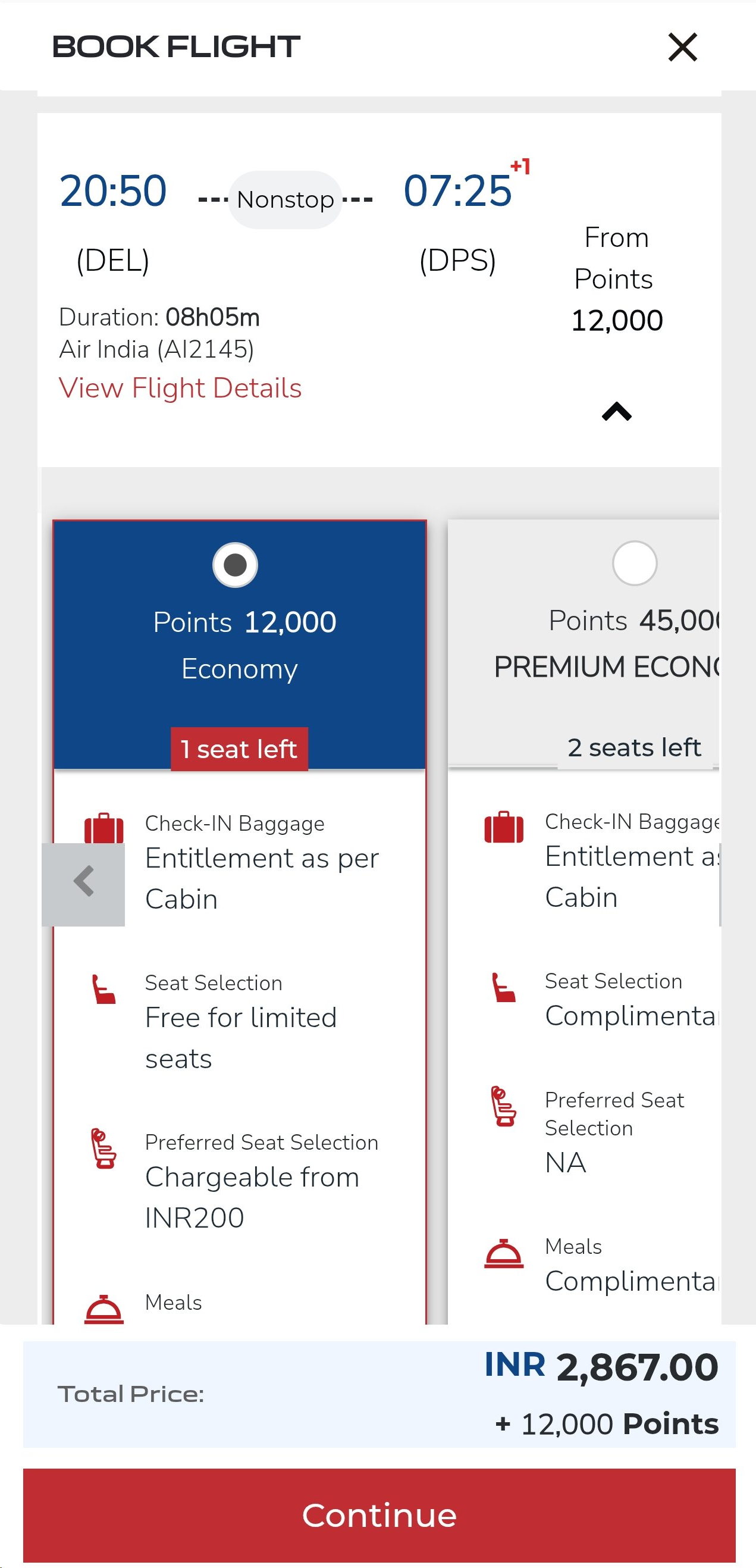
That is the real power of airline miles.
If you had redeemed 12,000 Tiger reward points as cashback, the value would have been limited. But when those same points are transferred to Air India at a 1:1 ratio, they can potentially unlock a flight worth ₹50,000+.
| Redemption Route | Points Used | Cash Paid | Approx Value Unlocked | Effective Value Per Point |
|---|---|---|---|---|
| Cash/voucher redemption | 12,000 Tiger RP | Nil | ₹4,800 | ₹0.40 per point |
| Air India Maharaja Club example | 12,000 Maharaja Points | About ₹2,867 taxes/charges | Approx ₹53,392 net value vs ₹56,259 fare | About ₹4.45 per point |
| Calculation | Value |
|---|---|
| Cash fare shown | ₹56,259 |
| Award taxes/charges shown | ₹2,867 |
| Net value unlocked | ₹56,259 - ₹2,867 = ₹53,392 |
| Points required | 12,000 |
| Approx value per point | ₹53,392 ÷ 12,000 = ₹4.45 |
| Cashback value of same 12,000 RP | 12,000 × ₹0.40 = ₹4,800 |
This does not mean every redemption will give this kind of value. Award availability, route, season, taxes and dynamic pricing will matter.
But examples like this show why Air India 1:1 transfer is the most important feature of the Tiger Credit Card.
For beginners, it is a simple entry into the points and miles game.
For pros, it is another no-cost way to quietly build Air India points for high-value redemptions.
Cashback vs Air India Value Illustration
| Points Earned | Cashback Value | If Maharaja Point Value Is ₹0.80 | If Maharaja Point Value Is ₹1.20 |
|---|---|---|---|
| 10,000 RP | ₹4,000 | ₹8,000 | ₹12,000 |
| 20,000 RP | ₹8,000 | ₹16,000 | ₹24,000 |
| 44,000 RP | ₹17,600 | ₹35,200 | ₹52,800 |
But There Is A Catch: Reward Exclusions Matter
This card is not meant for every spending category.
Accelerated rewards are not available on rent, insurance, utility bill payments, government transactions, education payments and real estate transactions. Fuel spends also do not earn reward points.
This is very important.
Many users see “up to 6 reward points per ₹100” and assume all spending will qualify.
That is not how this card should be used.
If your major annual spending is rent, school fees, insurance premiums, utility bills or fuel, this card will not perform the way you expect.
Tiger works best when your spends are in regular eligible retail categories, travel, shopping and international transactions.
Low Forex Markup: Not the best in the game
Most entry-level cards in India charge around 3.5% forex markup plus GST.
Tiger charges 1.5% plus GST.
This makes it a useful card for international spends, especially for people who do not have a zero-forex card or a premium travel card.
Now, it is not as clean as Scapia’s 0% forex proposition.
But Tiger has a different angle.
If you are already in the higher reward slab, your reward earning can partially offset the forex cost. At the top slab, you earn 6 reward points per ₹100. If redeemed as cashback at ₹0.40 per point, that is ₹2.40 value per ₹100, or a 2.4% reward rate.
So for someone who has crossed the higher annual spend slabs, foreign currency spends can become more attractive until and unless they doesn't have 0 forex card.
But remember, this only works if the transaction is eligible for rewards and if you are already in the better earning slab.
For occasional international travel, Tiger is a decent backup.
For heavy international spending, you should still compare it with true zero-forex cards like Scapia or other premium cards offering forex cashback or forex waiver campaigns like BOB Eterna, HSBC TravelOne
Forex Cost And Savings Calculation
| International Spend | Typical 3.5% + GST Cost | Tiger 1.5% + GST Cost | Approx Saving |
|---|---|---|---|
| ₹50,000 | ₹2,065 | ₹885 | ₹1,180 |
| ₹1,00,000 | ₹4,130 | ₹1,770 | ₹2,360 |
| ₹2,00,000 | ₹8,260 | ₹3,540 | ₹4,720 |
| Top Slab Forex Math | Value |
|---|---|
| Forex cost after GST | About 1.77% |
| Reward value at 6 RP/₹100 and ₹0.40/RP | 2.40% |
| Net paper position | +0.63% |
Airport Lounge Access: The Star Benefit
The star benefit here is effortless lounge access with no spending criteria attached.
That is rare in 2026.
Most banks have moved towards spend-linked lounge access. Some require ₹20,000, ₹50,000 or even higher spends in the previous month or quarter. Some cards have reduced visits. Some cards have complicated access rules.
Tiger keeps it simple.
| Lounge Type | Benefit |
|---|---|
| Domestic Lounge Access | 8 visits per year |
| International Lounge Access | 2 visits per year |
For a lifetime-free card, this is a very strong benefit.
This alone can make the card worth keeping if you take a few flights every year.
Even if you do not use Tiger for all your spends, lounge access without spend criteria makes it a valuable backup card in your wallet.
One airport lounge visit can easily save you ₹1,000 to ₹2,000 depending on the airport, food, waiting time and travel situation.
Now multiply that by multiple trips.
Suddenly, a zero-fee card starts delivering real value.
Lounge Value Illustration
| Lounge Benefit | Visits | Assumed Value Per Visit | Annual Value |
|---|---|---|---|
| Domestic lounge | 8 | ₹1,148 | ₹9,184 |
| International lounge | 2 | ₹2,214 | ₹4,428 |
| Total | 10 | Mixed | ₹13,612 |
BookMyShow Benefit
Tiger also offers a BookMyShow Buy One Get One movie offer.
| Benefit | Details |
|---|---|
| Offer Type | Buy One Get One |
| Maximum Benefit | Up to ₹500 |
| Frequency | Twice per year |
This is not a headline benefit, but it is a nice add-on.
It will not make or break the card.
But for a lifetime-free card, even occasional movie savings add to the overall value.
Golf Benefits
This is another surprising inclusion.
Tiger gives one complimentary golf game or golf lesson per quarter.
Golf benefits are usually associated with premium or super-premium cards. So seeing this on a lifetime-free card is genuinely interesting.
Will everyone use it?
No.
Most people will probably never touch this benefit.
But for someone who has access to golf clubs or wants to try golf lessons, this is a very good lifestyle add-on without annual fee pressure.
Fuel Surcharge Waiver
Tiger gives a 1% fuel surcharge waiver on eligible transactions.
The eligible transaction range is usually small-ticket fuel spends, so do not treat this as a dedicated fuel card.
More importantly, fuel spends do not earn reward points.
So if fuel is a major category for you, cards like SBI BPCL Octane or RBL IndianOil XTRA may make more sense.
Tiger’s fuel waiver is useful as a basic convenience benefit, not as a fuel optimization strategy.
Where The Card Really Shines
The IndusInd Tiger Credit Card shines in three places.
First, it is lifetime free.
That means the card does not need to work hard every single month to justify itself.
Second, lounge access comes without spend conditions.
This is becoming rare and valuable.
Third, the Air India 1:1 transfer gives the card a proper travel-rewards angle.
A lot of lifetime-free cards give basic cashback, basic points or small partner offers. Tiger tries to go one level higher by giving you access to airline miles, travel benefits and low forex in one package.
That is why this card is interesting.
It is not just a card for one category.
It is a travel backup card, a lounge card, a forex backup card and an Air India points card packed into a lifetime-free structure.
Where The Card Falls Short
Tiger is not perfect.
The reward structure looks better at higher spends, but at lower spends the earning rate is average.
The exclusions are important. Rent, insurance, utilities, education, government spends and fuel will not help you maximize the card.
The airline transfer ecosystem is also limited. Air India 1:1 is excellent if you are interested in Maharaja Club, but if you prefer Singapore Airlines, Qatar Airways, Air France, Accor or Marriott-style ecosystems, Tiger will not give you the same flexibility as premium cards.
Also, this card should not be compared directly with HDFC Infinia, Diners Black, Axis Atlas, HSBC TravelOne or Amex Platinum Travel.
Those cards have different roles.
Tiger is not trying to be the king of all credit cards.
It is trying to be a high-utility lifetime-free travel card.
And that is a very different positioning.
Final Verdict: Is IndusInd Tiger Credit Card Worth It?
The IndusInd Tiger Credit Card quietly makes sense because it gives you a strong travel-benefit stack at zero annual cost. It may not have the loudest reward rate or the widest transfer ecosystem, but a lifetime-free card with low forex markup, domestic and international lounge access, Air India 1:1 transfer, movie offers and golf benefits is a rare combination.
For beginners, it is an easy entry into the travel credit card ecosystem. For experienced users, it works as a smart backup card for lounge access, forex spends and Air India points without adding any annual fee burden. Tiger may not replace your premium card, but it can easily earn a permanent slot in your wallet because the cost of holding it is zero and the upside is genuinely useful.